

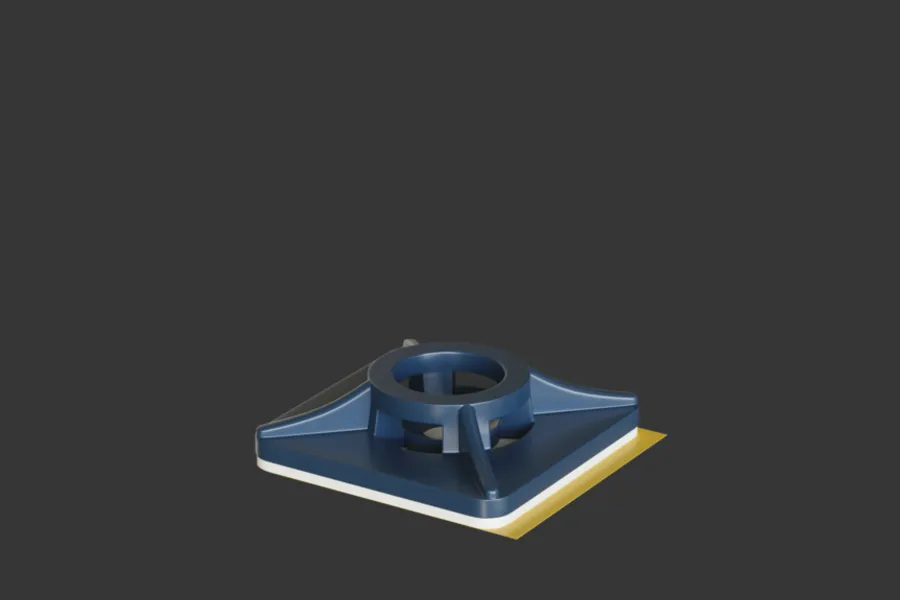
Detectable two -way adhesive cable tie mounts
Two-way detectable adhesive cable tie mounts for cable ties up to 6.0mm contain metallic pigments that make them detectable by metal detectors and X-rays.

The mount is the point where the cable tie grips the machine. If the slot is too wide the tie shifts, if it is too narrow the tie does not go through. Start from the width of the tie you already use and you get to the part number.
Nine part numbers, from a 4.0 mm tie slot up to 19 mm. All supplied in packs of 100, all available with four different adhesives, most of them also without adhesive and with a centre hole for a screw.
This is what picks the part number. The slot has to be equal to the tie width or slightly wider, not more.
| Tie slot up to | Part number | Directions | Base | Height | Material |
|---|---|---|---|---|---|
| 4.0 mm | 1129 | one | 19 x 19 mm | 6.0 mm | ABS |
| 4.9 mm | 1181 | one | 25.4 x 25.4 mm | 7.0 mm | PA 6.6 |
| 5.0 mm | 1104 | two, crossed | 19 x 19 mm | 5.0 mm | ABS |
| 5.0 mm | 1104BL05 | two, crossed | 19 x 19 mm | 5.0 mm | detectable PA 6.6 |
| 6.0 mm | 1130 | one | 27 x 27 mm | 8.4 mm | ABS |
| 6.2 mm | 1105 | two, crossed | 26.7 x 26.7 mm | 7.1 mm | ABS |
| 6.2 mm | 1105BL05 | two, crossed | 26.7 x 26.7 mm | 7.1 mm | detectable PA 6.6 |
| 8.6 mm | 1183 | one | 25.4 x 25.4 mm | 7.0 mm | PA 6.6 |
| 19 mm | 1150 | two, crossed | 50 x 50 mm | 6.6 mm | PA 6.6 |
One way: the tie passes in a single direction. The mount is simpler and in two cases out of three lower, so it takes less room where there is little space above the cable.
Two way: two slots crossed at 90 degrees. On the line you decide which way the cable leaves without changing part number, and it is the only version also available as detectable.
Part numbers 1104BL05 and 1105BL05 are moulded in PA 6.6 filled with metallic pigment: if a fragment breaks off and reaches the line, the metal detector and the X-ray scanner see it. They are blue, which in food processing is the conventional colour precisely because blue is rare in food and shows up immediately.
The last two letters of the part number are the adhesive. The plastic body is the same: what changes is how long it holds and at what temperature.
| Code | Adhesive | Service temperature |
|---|---|---|
| AS | Standard | -25 to +70 °C |
| AP | Special | -40 to +60 °C |
| CS | Standard acrylic | -40 to +100 °C |
| CP | Special acrylic | -30 to +105 °C |
| V | No adhesive, screw fixing only | as per the polymer |
Other adhesives on request, including those meant for continuous load and for low surface energy plastics. The criterion that actually matters is not the maximum temperature but how long the bond holds under load: we explain it with the numbers in the guide to choosing the double-sided tape.
Showing all 4 results
Two-way detectable adhesive cable tie mounts for cable ties up to 6.0mm contain metallic pigments that make them detectable by metal detectors and X-rays.
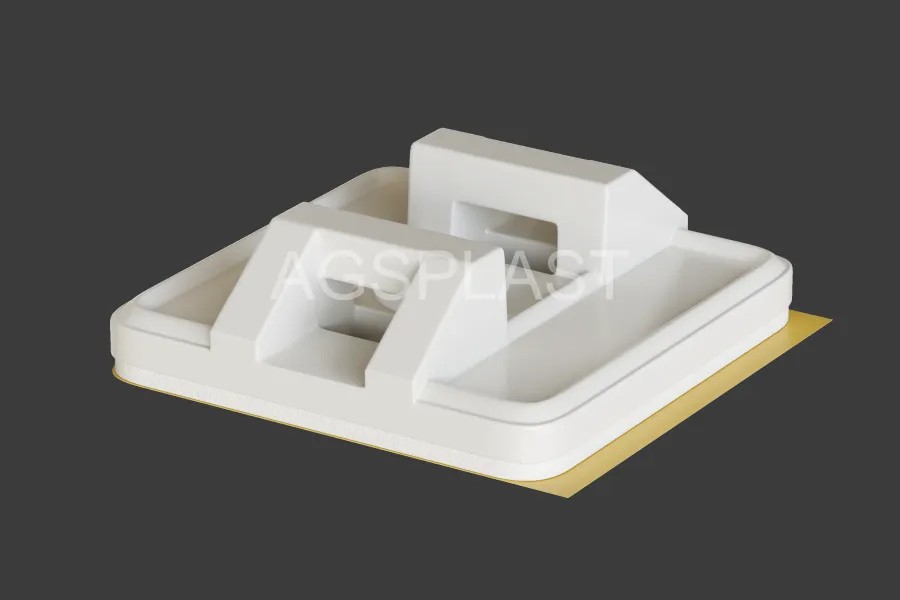
Our one-way adhesive cable tie mounts and cable ties up to 6.0mm wide allow for secure and neat cabling.
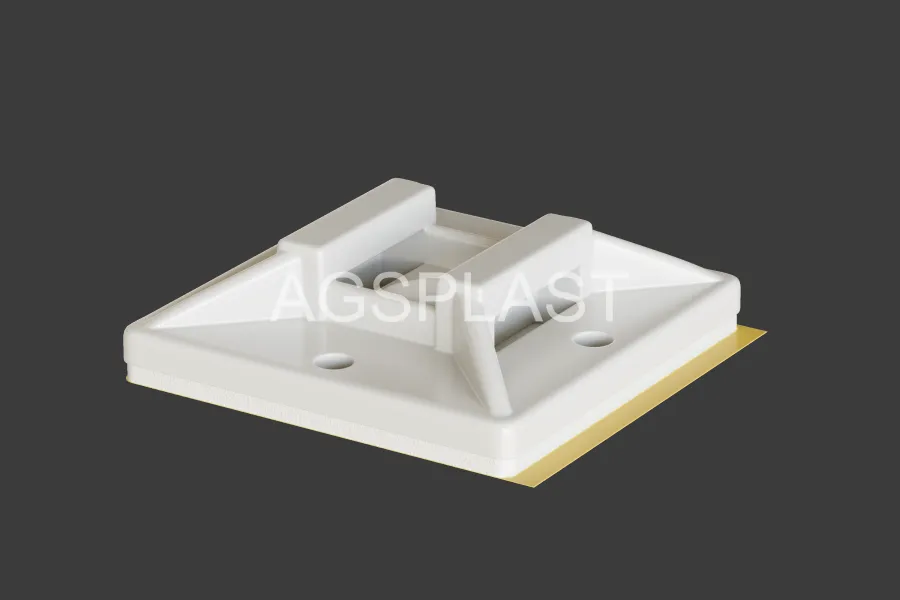
Our one-way adhesive cable tie mounts in PA 6.6 are ideal for cable ties up to 8.6 mm wide, allowing for neat and secure cabling.
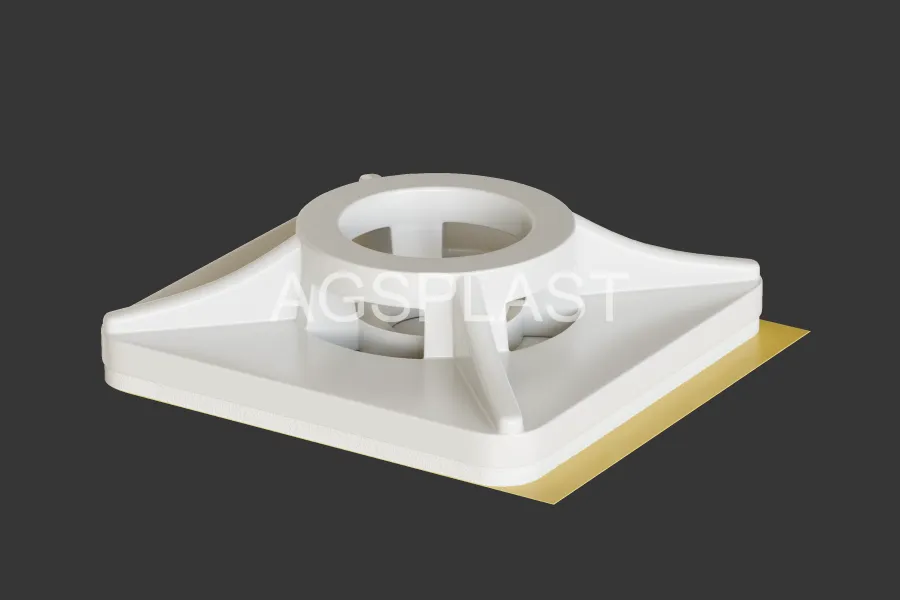
Our two-way adhesive cable tie mounts are ideal for cable ties up to 6.0mm and allow for neat cabling.
| Part numbers | Material | Flammability | Polymer temperature | Colours |
|---|---|---|---|---|
| 1129, 1130 | ABS (PA 6.6 on request) | HB to UL94 | -30 to +90 °C | Natural, black |
| 1104, 1105 | ABS (PA 6.6 on request) | HB to UL94 | -30 to +90 °C | Natural, black |
| 1181, 1183, 1150 | PA 6.6 | V2 to UL94 | -35 to +85 °C | Natural, black |
| 1104BL05, 1105BL05 | detectable PA 6.6 | HB to UL94 | -40 to +85 °C | Blue |
A point that often gets missed. The working temperature of the part is not the temperature of the polymer: it is the narrower of the two, polymer and adhesive. A 1181 in PA 6.6 is good to +85 °C, but with standard AS adhesive it stops at +70 °C, because the adhesive sets the limit. With standard acrylic CS the same mount reaches +100 °C and the plastic takes over again.
Other colours available on request. REACH, RoHS and IMDS compliance declared. Quality system certified to ISO 9001:2015.
Standard pack of 100 pieces for every part number and every adhesive version. Larger quantities and dedicated packaging on request.
Part numbers ending in V are the same mount without tape, fixed with a screw through the centre hole. They are used where adhesive is not suitable: oily surfaces, fresh paint, panels that go above the adhesive temperature limit, or when the specification requires mechanical fixing.
PA 6.6 is rated V2 to UL94 and reaches +85 °C. ABS is HB and reaches +90 °C: slightly better on temperature, worse on fire behaviour. If the specification asks for a UL94 class the answer is PA 6.6, and 1129, 1130, 1104 and 1105 can be moulded in PA 6.6 on request.
On a 1104 mount, 19 x 19 mm, with standard adhesive we measured about 110 N in tension, which is over 30 N per square centimetre, on bare unpainted metal. The bond is not at full strength in the first minute: it keeps growing over the following days. The tape comparison is in the double-sided tape selection guide.
If the size you need is not in the table, the part gets designed: we draw the component ourselves. How a custom project works.
AGSPLAST offers a complete range of adhesive bases for cable ties, suitable for any surface and holding requirement.
These supports allow installers to create neat cabling quickly and safely and can be used to secure and direct wires, cables, cable bundles, and tubes.
Adhesive bases are ideal in many situations, such as:
We also offer different types of double-sided tape to provide our customers with the best solution, ensuring no detachment issues and avoiding using unnecessarily expensive adhesives.
In our catalogue, you can choose from various types of adhesive bases:
Additionally, we offer four different types of double-sided tape, catering to different application needs:
The Fast-Fix bases are the most commonly used. They meet most fastening needs, particularly the most common ones, and with the Easy-Pill system, they allow installers to save up to 35% of application time, significantly reducing costs.
The materials used for their production are ABS and PA 6.6, with flammability ratings of UL94-HB and UL94-V2, respectively.

