


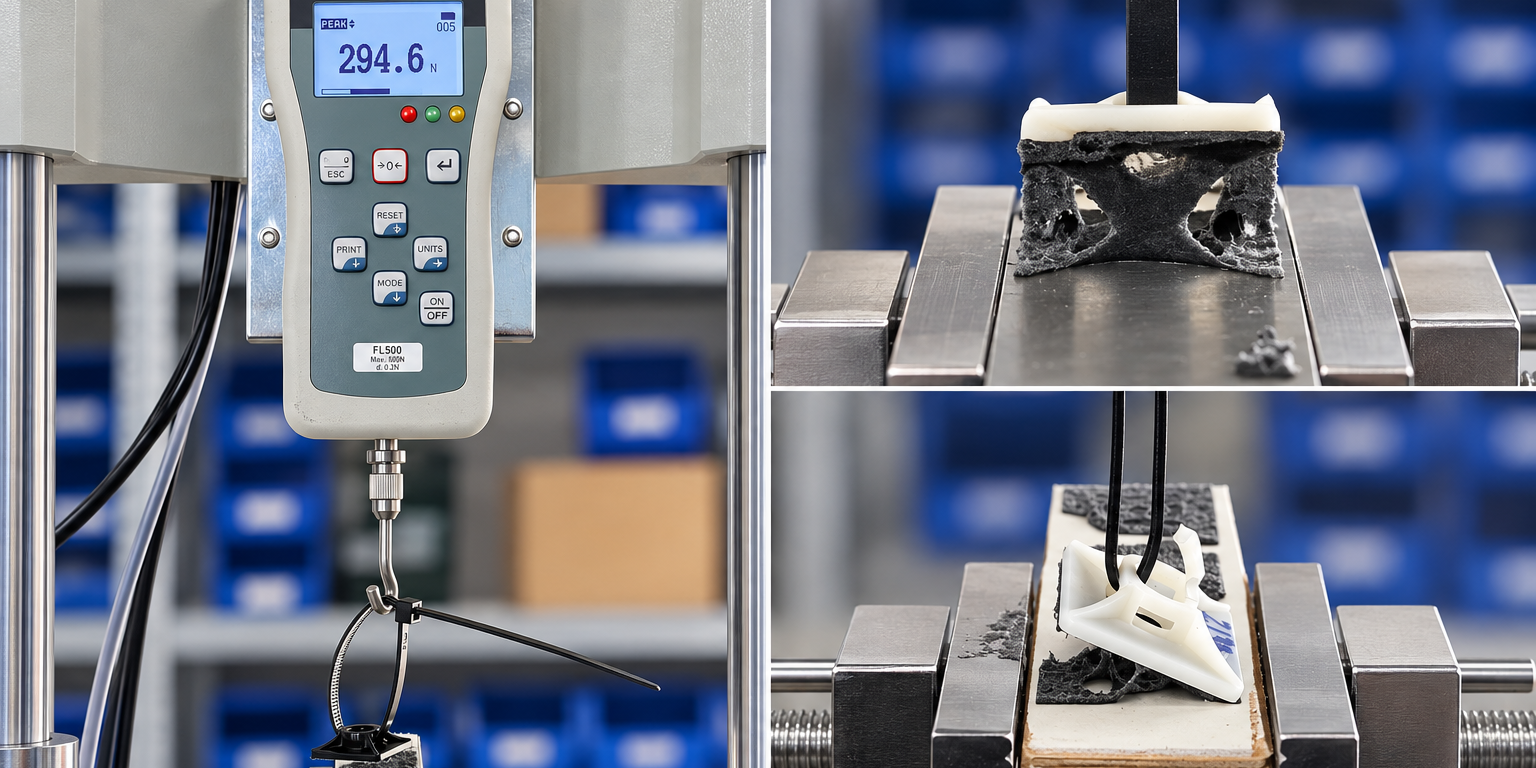
How much does an adhesive cable tie mount actually hold? On a metal surface, a 27×27 mm adhesive cable tie mount with our CX acrylic adhesive fails at 223 N on average, measured over 10 pull tests. The highest figure we have recorded is 294.6 N, on a PA 6.6 body. Freshly applied, before the adhesive has cured, it holds far less: in the test on painted wood the figure goes from 137 N to 213 N over the first 24 hours, one and a half times more.
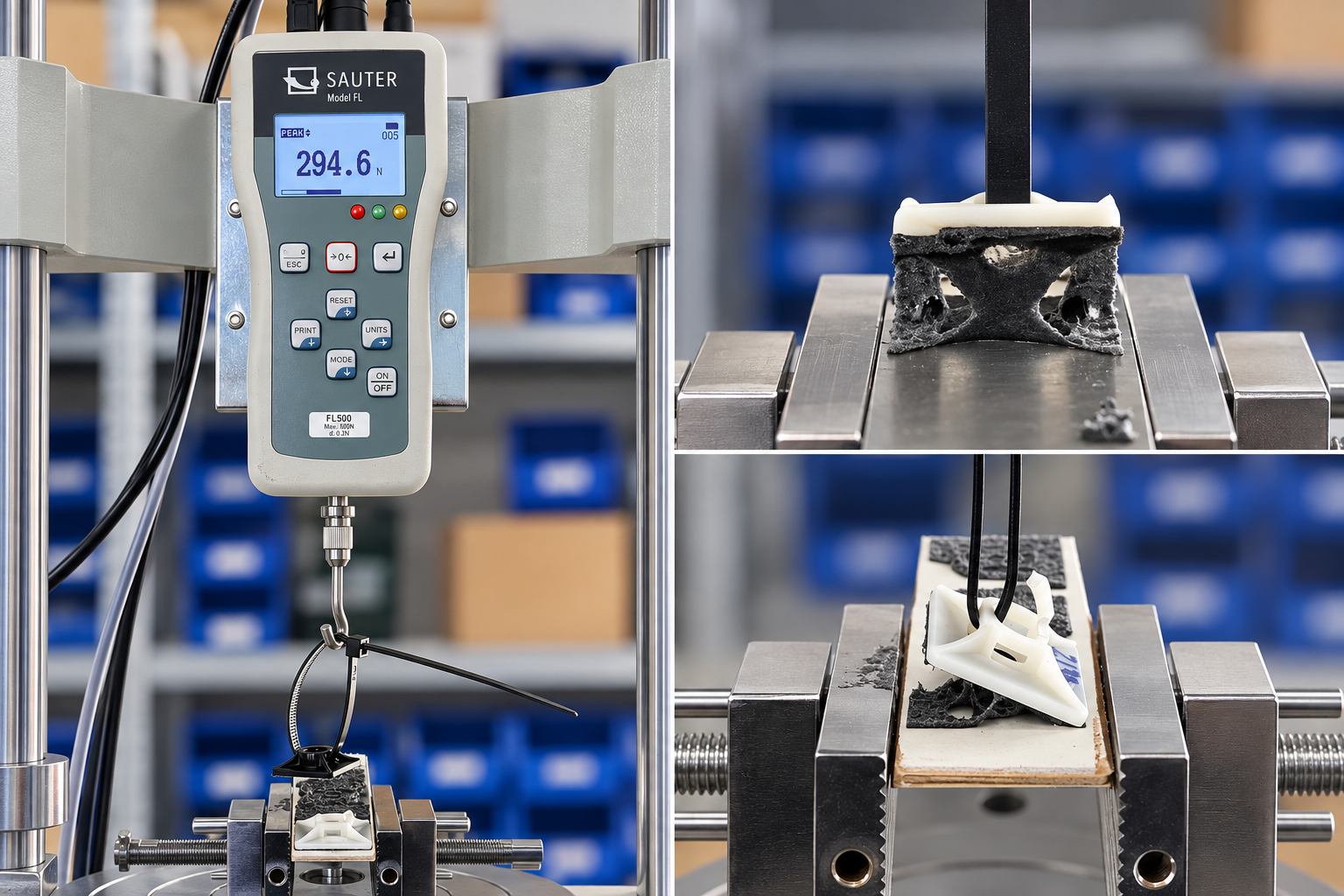
These are not catalogue figures taken from the adhesive supplier: they are measurements made in our own department with a force gauge. At the bottom of this page you will find the method and the criterion we use to count a test, because a number without a method is worth nothing.
One clarification that matters when you order: the figures on this page are measured with our CX acrylic adhesive. The catalogue line carries our standard double-sided adhesive, which covers the large majority of applications; if you need the holding strength or the temperature range of the CX, we fit it in production, with no change to the way you order. The comparison between the three adhesives is further down.
How much an adhesive cable tie mount holds, surface by surface
Test of 08/04/2024, CX acrylic adhesive, 27×27 mm mounts in ABS and in PA 6.6, measured after full cure.
| Surface | Average force at failure | Valid tests | Measured range |
|---|---|---|---|
| Painted metal | 230 N | 4 | 225 – 235 N |
| Aluminium | 218 N | 6 | 195 – 235 N |
| Painted wood | 213 N | 4 | 194 – 225 N |
Average across metals and painted wood: 220 N over 14 valid tests. Metals only: 223 N over 10 tests.
And on plastic? Here what decides is not the mount, it is the surface energy of the polymer, and our measurements on plastic are too far apart for a category average to tell anyone anything useful: that is why we do not publish one. What we can give you is the rule. On ABS, polycarbonate, rigid PVC and painted surfaces an acrylic adhesive holds well. On polyolefins, that is polypropylene and polyethylene, it does not hold, and it does not hold for any manufacturer: that is surface chemistry, not a product defect. If your application is on plastic we send you a free sample and you run the test on your own part, before you order.
The first 24 hours are worth one and a half times the hold
In the same test we measured the same mount on the same surface at three different moments. These are the figures, on painted wood:
| Time since application | Average force at failure |
|---|---|
| Immediately (time zero) | 137 N |
| 30 minutes | 176 N |
| After full cure | 213 N |
Between the moment you apply the mount and the following day the holding force grows by about 55%. This is why we state a 24 hour cure time: if the cable is put under tension straight away, you are using less than half of the margin you could have.
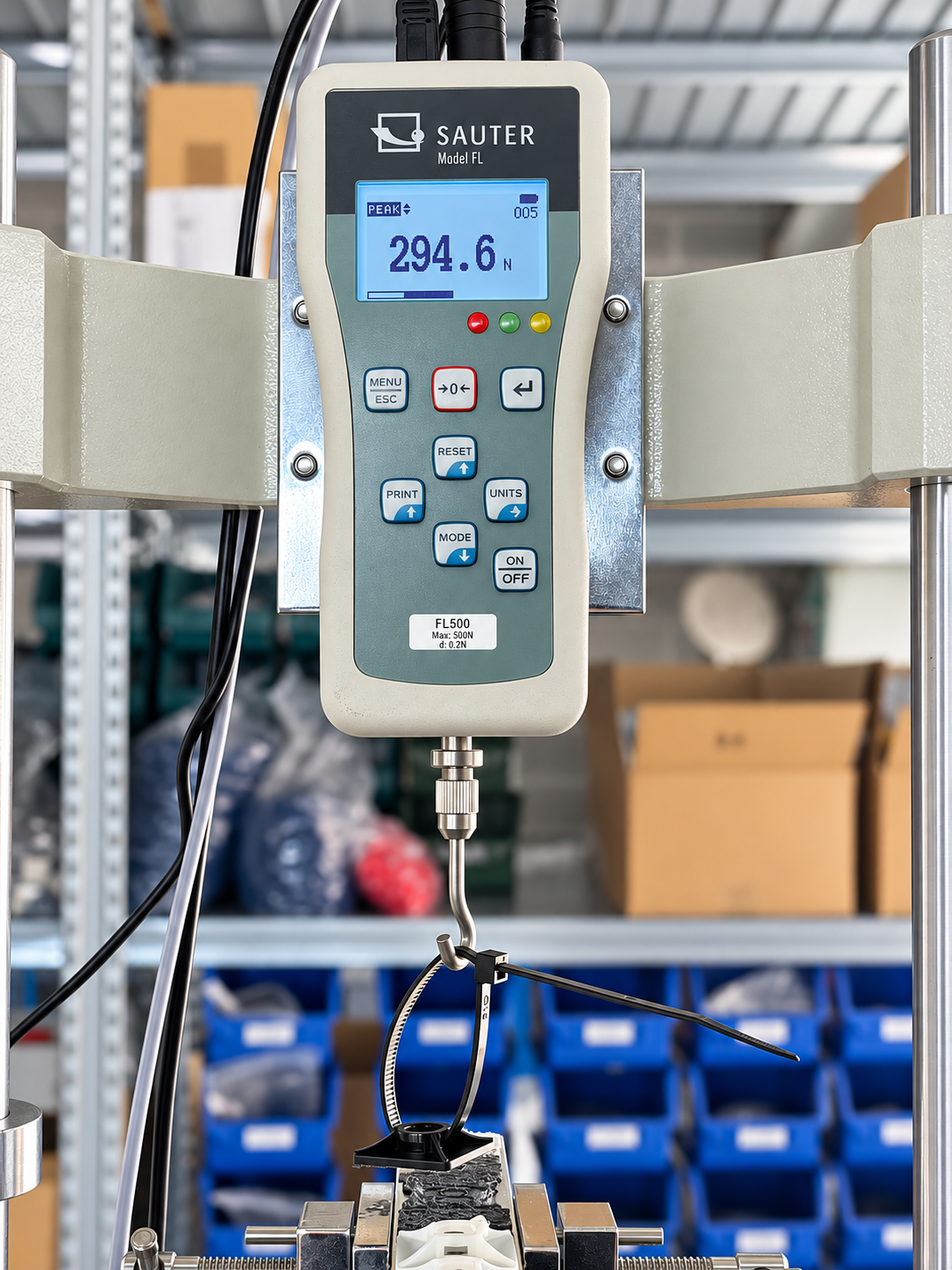
The peak: 294.6 N
In the test of 10/04/2024, on a PA 6.6 body, the CX adhesive gave an average of 275 N over four tests, with the highest figure at 294.6 N. To put it in perspective: that is roughly 30 kg hanging from a mount 27 millimetres to a side.
The test on video, from the start to the failure
ABS body or PA 6.6 body
At time zero the 27×27 mm mount fails at 83 N on average with a PA 6.6 body and at 91 N with an ABS body. After full cure the difference between the two materials narrows and the application surface matters far more.
What does remain is the behaviour in fire: PA 6.6 is classified UL94-V2, ABS is UL94-HB. If the specification calls for a V class, PA 6.6 is the way.
Every item can be ordered in the Natural version, that is in the natural colour of the plastic, and in the Black version.
The three adhesives and their temperatures
The catalogue line carries our standard double-sided adhesive, and that is the one covering the large majority of applications. When more holding force is needed, or a wider temperature range, nothing changes for you: we fit a different adhesive ourselves, in production. Same code, same size, same assembly, same way of ordering. More hold with no extra effort on your side.
| Family | Chemistry | Service temperature | Application temperature | When it is used |
|---|---|---|---|---|
| Standard (main line) | TR7129 synthetic rubber on HD expanded polyethylene, 0.8 mm | -30 to +60 °C | +15 to +40 °C | The adhesive of our catalogue line. Tack 20 N/25 mm, tensile strength 100 N/cm² |
| CX acrylic | TA1860 self-crosslinking acrylic on closed-cell expanded polyethylene, 0.8 mm | -40 to +100 °C | +15 to +50 °C | When high temperatures are involved: it withstands up to +100 °C |
| Special high hold | Rubber on cross-linked closed-cell polyethylene foam, 0.9 mm | -40 to +60 °C | from +10 °C | When prolonged shear resistance is needed: shear beyond 5,000 hours. Registered in IMDS for automotive |
Mind the difference between service temperature and application temperature: an adhesive that withstands 100 °C in service still has to be applied above 15 °C, otherwise it does not develop adhesion.
Four rules for getting the application right
- Degrease the surface. The only test we had to discard for lack of adhesion was on a surface that had not been cleaned properly.
- Press, do not just rest it. Adhesion depends on real contact between the adhesive and the surface: the pressure at the moment of application makes the difference.
- Wait 24 hours. These are the 137 N that become 213 N in the table above.
- Respect the minimum application temperature. Below 15 °C (10 °C for the special adhesive) the adhesive does not develop adhesion. This holds even if, in service, the same adhesive withstands -30 °C: applying it is one thing, using it is another.
How we measure, and which tests we discard
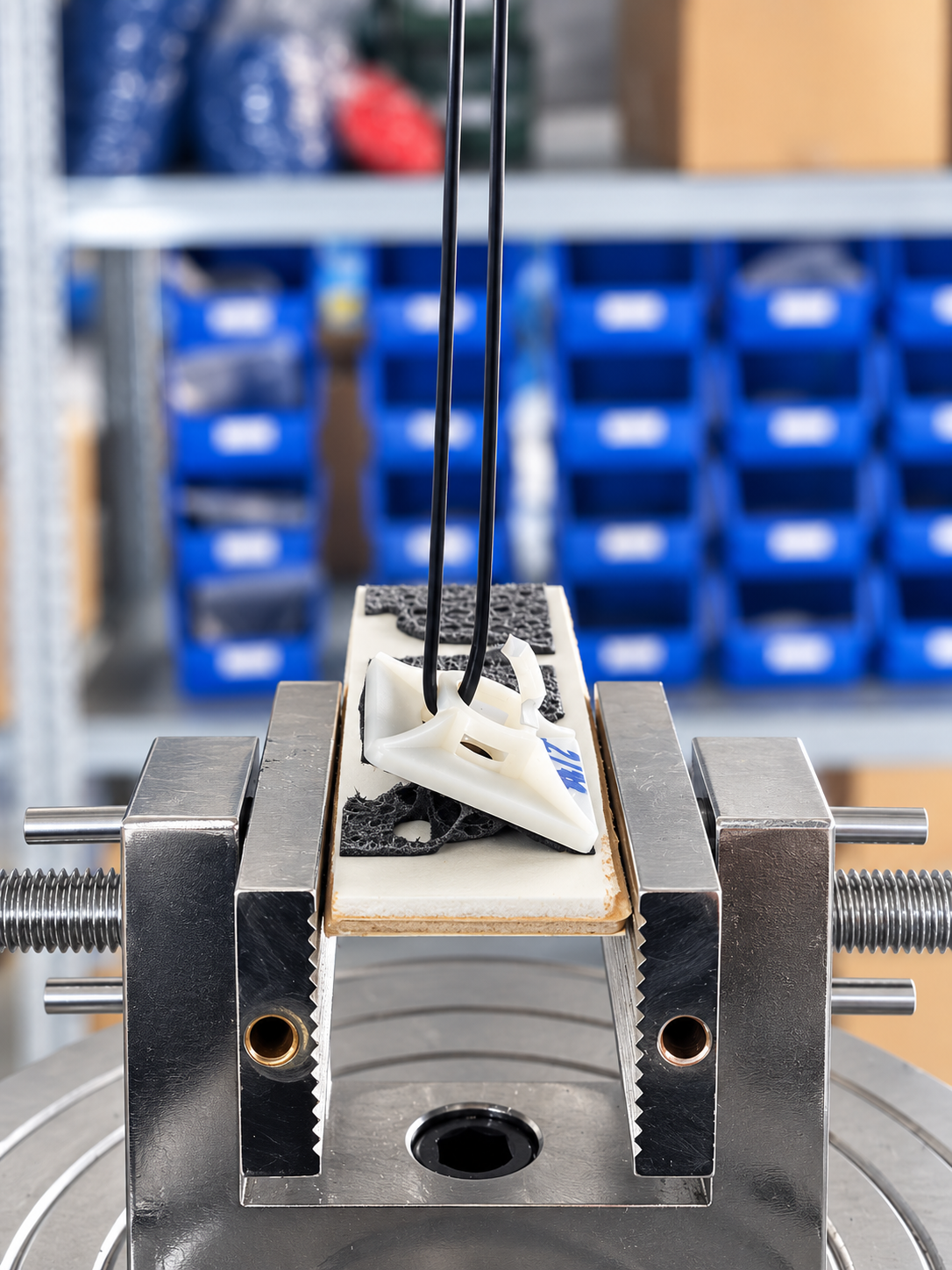
The test is a pull test to failure. The mount is applied to the surface, left to cure, then pulled until it gives way through a cable tie passed through the slot, that is in the same direction in which it works in the field. We record the peak force and note where the failure occurs: in the adhesive, at the surface or in the body. The instrument is a Sauter FL500 force gauge, 500 N full scale and 0.2 N resolution, on a bench with a vice.
We repeat every condition on several samples, because a single figure means nothing. The averages on this page always state how many tests they are made of.
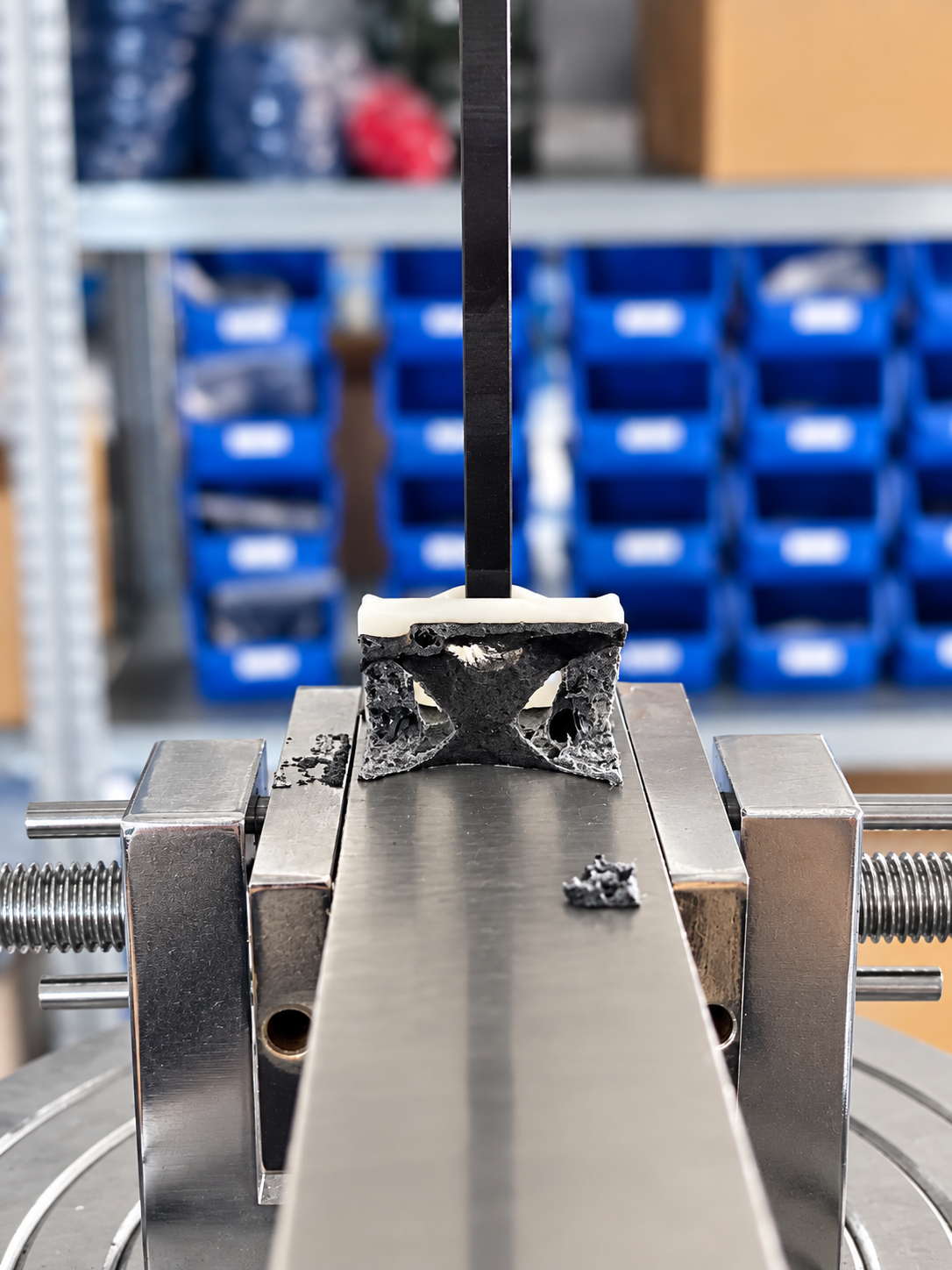
The criterion by which we discard a test is one and one only: the defect has to be recorded in the test log while the test is being run. The part slipping out of the vice, an off-axis pull, a surface not cleaned properly. In the test of 08/04/2024 this meant discarding three tests out of twenty-one, and one of the three discarded was a high figure (221.4 N), not a low one.
We do not discard a test because the figure is low: the only reason for exclusion is a defect recorded in the log while the test is being run.
We run these tests when we qualify a new adhesive and when a customer asks us about the hold on a particular surface. If you need a figure on your own surface, we can measure it.
Compliance
The items on this page are the adhesive cable tie mounts of our catalogue; we fit the same adhesive on adhesive cable clips and on screw mounts for cable ties as well. How we apply the adhesive in production is described on the adhesive application page.
The products comply with REACH, RoHS and California Proposition 65. AGSPLAST S.r.l. operates a quality system certified to ISO 9001:2015. We mould and assemble the mounts in our own plant in Albignasego, in the province of Padua, Italy: it is also the reason why we can fit a different adhesive on request and measure the hold on your surface in a short time. The REACH regulation and the UL94 flammability classes are the references we are asked for most often in supplier questionnaires. The special high hold adhesive is registered in IMDS, the automotive material database.
Frequently asked questions
How much does an adhesive cable tie mount hold?
In our pull-to-failure tests, with CX acrylic adhesive and a 27×27 mm body, the average on metal is 223 N over 10 tests, with a measured peak of 294.6 N. On painted wood the average is 213 N.
How long should I wait before putting the cable under tension?
Twenty-four hours. Freshly applied, the mount fails at 137 N; after full cure, at 213 N: the first 24 hours are worth one and a half times the hold.
Does it hold on every plastic?
No. On ABS, polycarbonate, rigid PVC and painted plastics it holds well; on polyolefins such as polypropylene and polyethylene an acrylic adhesive does not hold, and that applies to any manufacturer. On plastic we send a free sample to be tested on the real part.
What temperature does it withstand?
It depends on the adhesive. The standard works from -30 to +60 °C, the CX acrylic from -40 to +100 °C, the special high hold from -40 to +60 °C. The application temperature is a different matter: minimum +15 °C, +10 °C for the special adhesive.
Can I have a stronger adhesive without changing the item code?
Yes. We fit the adhesive ourselves in production: same size, same code, same way of ordering.
Are the mounts made in Italy?
Yes, moulded and assembled in our own plant in Albignasego, in the province of Padua.
Test it on your own surface
We send you a free sample of the items you are interested in, so you can run the test on your own part instead of on a datasheet.

